

The first thing you will notice when looking at a rhododendron is its size. They are often much taller than azaleas. This is because they are generally grown for their height rather than their width.
Rhododendrons are also generally wider than azaleas, and, well, just bigger!
Another major difference between the two is the shape of their blooms. Rhododendrons have symmetrical clusters of bell – shaped blooms that look like a starburst.
That’s not the complete difference between Rhododendron vs Azalea, for the full story, please read on.
The genus of a plant contains a variety of different species, which brings us to the differences between Azaleas and Rhododendrons (Rhododendron spp.).
The Genus Rhododendron
Azaleas and rhododendrons have the same kingdom, phylum, class, order, and family. Both are in the Plantae kingdom and share the same classifications all the way down to the Ericaceae family.
The Ericaceae family of plants are flowering plants that contain over 4,000 species, making it one of the largest families of plants in the world.
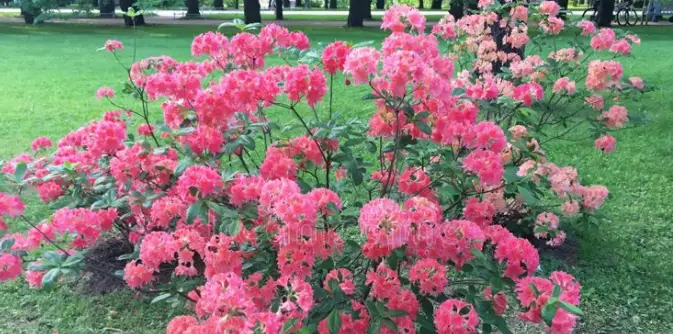
These are among the most beautiful of all flowering shrubs and trees and it is unfortunate that their requirements are so specific that they can be grown successfully in only a limited number of regions.
Botanically, azaleas are included in the genus rhododendron, making them part of the Rhododendron family, but, gardeners continue to refer to them as Rhododendrons azaleas. All of them belong to the genus Rhododendron, but not all Rhododendrons are Azaleas.
Rhododendron genus varieties have foliage which is usually handsome — often larger than that of azaleas, sometimes leathery in texture, dark green on the upper surface and pale on the underside, and carried in whorls. Many of the evergreen species are decorative throughout the year.
The large round heads of flowers make a glorious show from late winter to late spring. Rhododendrons grow magnificently in many parts of England, but they are not native to that country. Most plants in England and other parts of Europe are derived from the first plants imported at the beginning of the nineteenth century.
Some of these were from America and Spain, but most of them were from the East, the Himalayas, China and Tibet, such as vireya rhododendrons. It is recorded that there are now something like 500 species in cultivation and thousands of named cultivars.
Each year sees the introduction of more of them, and keen growers are advised, therefore, to consult nurserymen who will know the names of those likely to thrive in their area, or to study the Rhododendron Year Book.
Rhododendrons Size
Some grow to tree size, spreading across 3 m (9.84 ft) whilst others are less than 1 m (3.28 feet tall) in height and spread. The form and colors of the flowers and leaves vary, too.
The Difference Between Azaleas & Rhododendrons
Now that we know about the Rhododendron genus and that the two species come from the same family but indeed have a few differences, let us have a closer look at these differences.
Bloom Time
Rhododendrons typically start blooming later during spring whereas azaleas will start blooming at the start of April already — not counting the species that repeatedly blooms.
The Difference Between Azalea & Rhododendron Flowers
Looking at Azaleas, you will notice that they have somewhat fennel-shaped or tubular flowers. They actually only produce one flower per stem, but the shrub will look as though it is covered in flowers due to the large amounts of stems that it can grow.
Rhododendron flowers, on the other hand, are typically bell-shaped, and they have a lovely way of growing in beautiful clusters at the end of each stem or branch.
Both species carry five lobes per flower.
Stamens
The pollen producing part, also known as the stamen, also differs between these two species of flowers.
The Rhododendron, you will notice upon closer inspection, has ten or sometimes more stamens, they have two stamens per lobe.
The Azalea has one stamen per lobe, making them a total of five stamens per flower.
Flower Colors
The color of flowers in Rhododendrons and Azaleas also differs.
Azaleas have a far greater color spectrum than Rhododendrons have.
The Rhododendron colors are typically limited to orchid pink flowers, as well as red, purple, white and the occasional yellow shade.
Azaleas have a vast color pallet. Its exquisite colors consist of different shades of red, pink, cream, white, purple, lavender, yellow and orange.
Foliage
The Azalea plant carries foliage that is oval shaped. The leaves are thin and flexible and most Azaleas shed their leaves annually. Some species are, however, partly deciduous or evergreen, this depends on the cultivar as well as the climate surrounding the shrub while it is growing.
Rhododendron foliage — quite the opposite of that of the Azalea, grows to resemble the shape of a paddle. The leaves are large, thick and evergreen. When inspecting the undersides of these shrub leaves, you will notice quite a scaly texture and some leaves may also have tiny dots on their undersides.
Soil
Both for Azaleas and Rhododendrons, you should choose a soil that is filled with nutrient rich organic matter, one that remains moist and is well draining at the same time. These species of shrubs thrive best in this type of soil.
The ideal soil pH for both of these flowering species ranges from 4.5 to 6.0. They thrive best and grow well in acidic soil.
If you are not sure about the pH level of the soil in which you choose to plant your shrub, simply conduct a soil test before placing your shrub into the soil.
If you find that the soil is too alkaline, meaning too high, add a bit of iron sulfate or agricultural sulfur to the soil in order to decrease the pH.
If, on the other hand, your soil test reveals that your soil pH is too low, adding a bit of ground limestone to the soil will certainly increase the pH a bit more.
Soil Preparation
Due to the delicate and shallow roots of both Rhododendrons and Azaleas, they often have a hard time growing through soil which is too dense or compacted.
When planting these two shrubs, start by digging a hole in the ground. Make sure that the size of the hole is double as wide as the plant’s root ball and avoid digging it too deep. Place the plant into the whole ensuring that it is close to the surface or 1-2 inches higher than the soil around it and close the hole with planting soil. Loamy topsoil of good quality is best to use for the entire area that you are going to use for planting.
Good drainage is very important for the health of shallow rooted plants such as the Rhododendron and Azalea.
Sunlight & Location
Be sure to place both Azaleas and Rhododendrons in an area where they are protected from the harsh rays of the afternoon sun. Rhododendrons prefer to grow in an area that is cool with dappled shade. These shrubs may tolerate a bit of morning sunlight, but they prefer sunlight that is filtered — through a sheer curtain, for example.
If you wish to purchase and grow an Azalea, but you have no means to provide it with filtered sunlight, be sure to get a deciduous Azalea rather than getting one that is evergreen. Azaleas that are deciduous can generally handle more direct sun.
When planting these shrubs outside, be sure to find a spot which slopes to the east or the north. These spots are often protective from the cold winter west and south winds. This type of wind may dry out your evergreen Azaleas and rhododendrons by evaporating water from their foliage.
Be careful of freezing winter temperatures, they may cause the ground to freeze over. Frozen ground prevents water from getting to plants, resulting in your azaleas leaves turning brown.
Water
Looking at Azaleas, you will find that their root system is relatively shallow. It is important to water this shrub when the conditions surrounding it are dry. Using a drip irrigation system or soaker hose is a great way to ensure the slow watering of this shrub.
Overhead watering should always be avoided. Prolonged moist foliage makes great grounds for plant diseases.
Never water too much. Overwatering and excess amounts of water may cause a disease known as root rot. This can be fatal to your plant.
Mulch
Mulching — which is great to do in order to keep the root ball moist and cool — can be done by covering the root ball with a 2-3 inch layer of organic mulch. Decomposed oak leaves, composted pine bark, pine needles and pine straw are great to use as they all add vital nutrients enriching the soil when they start decomposing.
When applying mulch, try to avoid the main stem by keeping the mulch a few inches away from the flower stalk. Creating what is known as a mulch volcano is a mistake that is commonly made, and it does not benefit your shrub. Heavy piles of mulch around the stem of the plant cause it to be too wet, creating the ideal ground for stem rot.
During the fall, before the ground starts freezing, replenish or replace the mulch.
Fertilizer
Rhododendrons and Azaleas like to be fed occasionally. In fact, they need a bit of nutrient supplements every now and again. To find out whether your shrubs need some fertilizer, simply do a soil test to find out.
When using fertilizer on these two beautiful species of shrubs, be sure to use one that is especially made for Azaleas and Rhododendrons. Always be cautious when applying it, as you do not want to end up damaging its fine roots.
A great choice of fertilizer is one that can supply ammonium nitrogen. Cottonseed meal is also a great alternative and will work when being used as a fertilizer.
The ideal time to fertilize Azaleas and Rhododendrons is early spring, when the weather carries with it ample amounts of moisture.
They should never be given ordinary fertilizer. Fertilizers specially prepared for plants which require acid soil may be applied from time to time.
Pests
Lace Bugs and spider mites are among the most common pests found on Azaleas. By practicing good cultural habits, these problems are very easily avoided. Lace Bugs, for example, are often found attacking Azaleas when they are left to grow in conditions of full sun.
Choosing a good location for your plant, providing it with good drainage, and soil aeration, having good watering habits and careful mulching practices, will all practice towards the prevention or treatment of pests and diseases.
Diseases
Rhododendrons and Azalea plants are quite susceptible to phytophthora root rot when conditions are hot and moist.
Another destructive disease often found in Azaleas is leafy gall. It often occurs during spring and this issue is especially damaging to the plants’ foliage. To control or treat this plant disease, make sure you handpick all the leaves that are infected. This is the most effective way to help your plant when it has contracted this disease.
Deadheading
Deadheading is not really necessary in these shrubs. The majority of them clean themselves. When blossoms start turning brown, they fall off after a few days and then get absorbed into the mulch. It might look a bit unattractive for a few days, but if you give it some time, your shrub will be looking pretty again in no time.
Pruning
If you are an owner of Azaleas, you should know that one should prune them once they are done blooming.
Most commonly, fresh flower buds will be ready to bloom by about midsummer. Pruning azaleas around the middle of June, may cause the plant to produce any flowers when the following spring arrives.
Go about pruning by removing the branches until you reach a place where a few larger branches are joined together.
Large branches may also be cut back if you wish to reduce the size of an overgrown shrub. The parts that remain will start producing new and healthy growth.
Prune away any dead flowers.
Types Of Azaleas & Rhododendrons
Now that we are more familiar with the differences between these two wonderful pieces of greenery, let us have a look at some of the more popular types. There are a dozen choices and with this guide we hope that you find the ideal choice for you.
Azaleas
There are a handful of varieties of Azaleas. Read on to learn about the most popular examples of azalea species, including evergreen Azaleas and deciduous Azaleas.
Rhododendron Daviesii
This deciduous Azalea shrub is beautiful and compact, rich with a lovely fragrance. It carries delightful and elegant, funnel-shaped flowers. These creamy-white flowers, also present with a lovely yellow flare, making them exceptionally beautiful.
Its foliage is bluish-green in color, creating an amazing contrast together with its showy blossoms which pop out from pink buds starting around spring to early summer.
This hardy variety derives from several American species belonging to the Ghent hybrid Azaleas and, when planted in masses, never fails to amaze.
Rhododendron Gibraltar
Another one of the amazing deciduous Azaleas — an award-winning one in fact. This stunning medium-sized deciduous Azalea grows amazingly beautiful ball-shaped clusters of flowers which are formed by a group of 10-12 flowers.
During late spring, bright orange flowers open up from their deep crimson buds, displaying a 3-inch wide elegant blossom with a touch of red, orange and gold.
Although not as fragrant as the fore mentioned Rhododendron daviesii, this shrub, along with beautiful narrow green leaves, makes for an exceptional floral display.
What makes the Rhododendron gibraltar even greater, is that it is extremely hardy and greatly mildew resistant.
Rhododendron Girard’s Fuchsia
This lovely medium-sized Azalea is quite the winter-hardy shrub. It is semi-evergreen and produces clusters of beautiful flowers shaped as funnels, blooming in purple and pink shades.
Their foliage is handsome and small. They display glossy, narrow leaves of an olive green color, which, interestingly, start showing reddish tones during winter, creating an amazing contrast with their deep purple-pink flowers.
Rhododendron Homebush
This type of Azalea is mostly known and loved for its luminous flowers. This one, too, is a multiple award-winning small deciduous plant producing masses of flowers. It’s lovely rose-pink flowers grow in compact oval trusses, grouping about 14 to 16 rose-pink flowers in one cluster.
The flowers bloom in late spring, growing to resemble the shape of a trumpet, reaching about 1.5 inches in width.
The homebush carries leaves which also happen to be mildew resistant. The leaves are elliptic and light green.
Rhododendron Klondyke
The Klondyke azalea is another popular azalea. This, too, is a medium-sized deciduous Azalea.
Its flowers grow in groups of 8 to 15 eye-catching golden-yellow blooms. They are funnel-shaped and displayed in exquisite clusters. Upon closer inspection, you will notice a lovely and delicate tinge of red rimming the outside of the blooms.
Blooming during early spring, the flowers create an amazing contrast with their unique foliage, which is copper-red in color, changing to a deeper bronze in fall.
Rhododendrons
Continue on for some brief information on the most popular types of Rhododendron species.
Rhododendron Goldkrone
This winter hardy shrub is an exquisite evergreen Rhododendron. It produces show-stopping clusters of 16-18 flowers. They are shaped like trumpets and golden-yellow in color. The trusses can reach a width of 2.5 inches and what makes the blooms even more unique is that they are lightly freckled, displaying tiny reddish-yellow spots on their upper lobes.
This is a late season shrub, only starting to bloom in late spring through early summer. The blooming Rhododendron creates a great contrast together with its dark green leaves, which are slightly curled and ovate, making any landscape lovely to look at.
Rhododendron Mary Fleming
If you have a small garden, these pretty evergreens are perfect plants for small gardens and rockeries. When in bloom, they produce lovely cream-colored flowers with wavy edges. They are displayed with a tinge of salmon pink, showing off a darker pink stain closer to its throat.
This dwarf Rhododendron blooms in mid-spring and carries very handsome foliage. Its small leaves start off by carrying a bronze color, turning dark green as they mature, and then going back to displaying bronze tones as the winter approaches.
Mary Fleming is quite hardy, tolerating both hot climates and sun as well as cold climates, making it extremely winter hardy.
Rhododendron Nestucca
This Rhododendron hybrid is extremely heat and sun tolerant. It is compact and evergreen and when in bloom, it produces amazing trusses of 12-15 flowers displayed in a dome shape.
Each individual flower is in a funnel shape. They are white and can open up to be 5 inches wide. The blooms are elegantly frilled, showing delicate brown spots towards their throat.
Below these luminous blossoms, you will find dark green leaves which are elliptic and glossy.
Rhododendron Nova Zembla
Known for its extraordinary cold hardiness, this small-sized evergreen produces amazing red flowers displaying on their upper lobes lovely deep maroon blotches. Their flowers are shaped like trumpets, together forming lovely round trusses.
This popular red Rhododendron carries thick, dark green glossy leaves.
Rhododendron Roseum Elegans
This lovely evergreen is prized for its large broad leaves carrying above them amazing bunches of beautiful lavender flowers shooting out from lovely flower buds.
Each truss can be made up of up to 20 elegant bell-shaped flowers carried at the ends of upright branches. As time passes, the flower’s color changes to pink, creating an attractive contrast with the shrubs’ lovely and glossy olive green leaves.
It is quite a heat and cold tolerant shrub introduced and raised by A. Waterer.
Conclusion
This concludes our article on the differences between Rhododendrons and Azaleas. We hope that this guide will help you to know the differences when wanting to purchase any of these lovely shrubs and add them to your dream garden.
To learn more, join the American Rhododendron Society. They run a database with loads of information on over 2000 different Rhododendrons and Azaleas.

Resources;